




PI-RADS v2.1 Quick Guide
PI-RADS v2.1 is a standardized prostate MRI scoring system used to estimate the likelihood of clinically significant prostate cancer and communicate findings consistently.
Peripheral zone: DWI is dominant
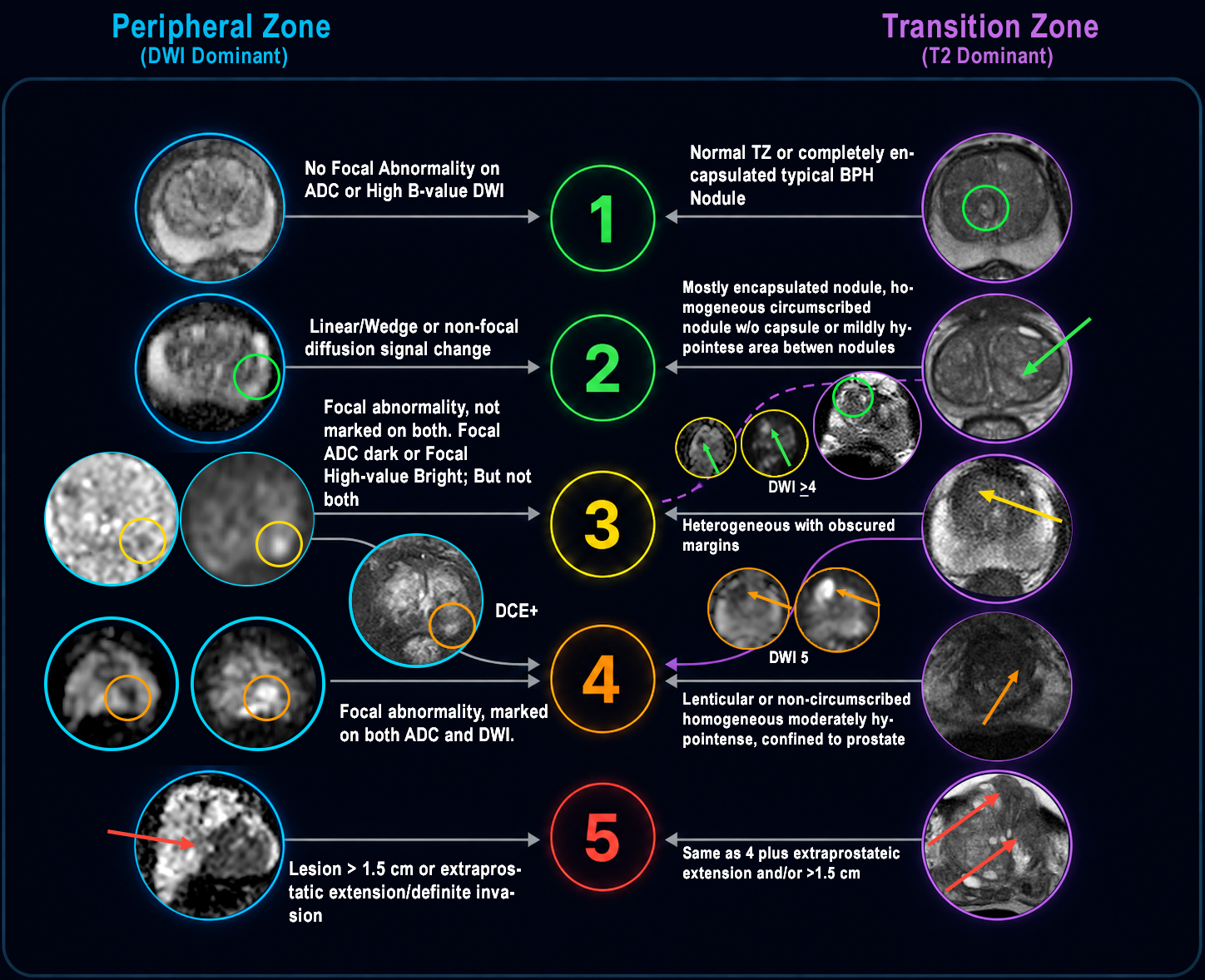
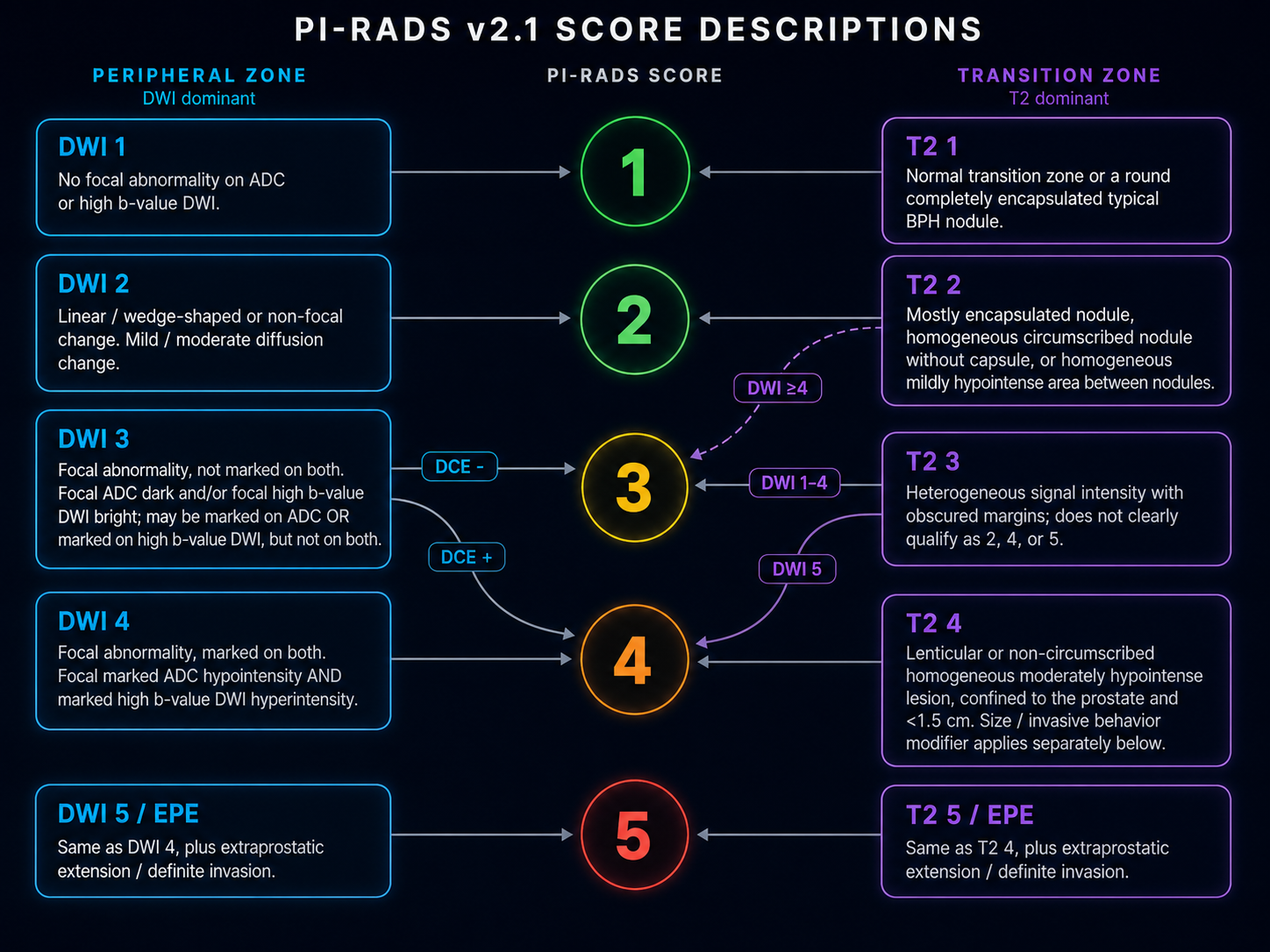
Peripheral zone lesions are scored primarily by ADC and high b-value DWI. A focal lesion that is dark on ADC and bright on high b-value DWI is more suspicious than a vague, linear, wedge-shaped, or diffuse abnormality.
Transition zone: T2 is dominant
Transition zone lesions are scored primarily by T2 morphology. Suspicious features include a lenticular or non-circumscribed shape, homogeneous moderate T2 hypointensity, and more invasive behavior. DWI can modify selected borderline TZ lesions, but it is not the dominant sequence.
When does DCE matter?
DCE has a limited but important role. In the peripheral zone, positive focal early enhancement can upgrade an otherwise PI-RADS 3 lesion to PI-RADS 4. DCE generally does not drive transition zone scoring.
Image quality caveat
If DWI or DCE is technically inadequate or not performed, PI-RADS assigns that component an “X.” Inadequate DWI is a major limitation, especially for peripheral-zone assessment. If DWI and DCE are both inadequate or absent, assessment should be limited to staging for extraprostatic extension.
When DWI/ADC Is Nondiagnostic
Susceptibility artifact, commonly related to adjacent rectal gas, may render DWI and ADC nondiagnostic. In this setting, the DWI score may be recorded as X. An overall PI-RADS category may still be assigned when T2-weighted imaging and DCE are adequate, using the PI-RADS v2.1 Assessment Without Adequate DWI pathway. The report should describe the technical limitation and acknowledge reduced diagnostic confidence. Repeat DWI should be considered when the cause of artifact can be corrected. If DCE is also inadequate or absent, a standard lesion PI-RADS category should not be assigned, and assessment is limited to evaluation for extraprostatic extension.
Bottom line
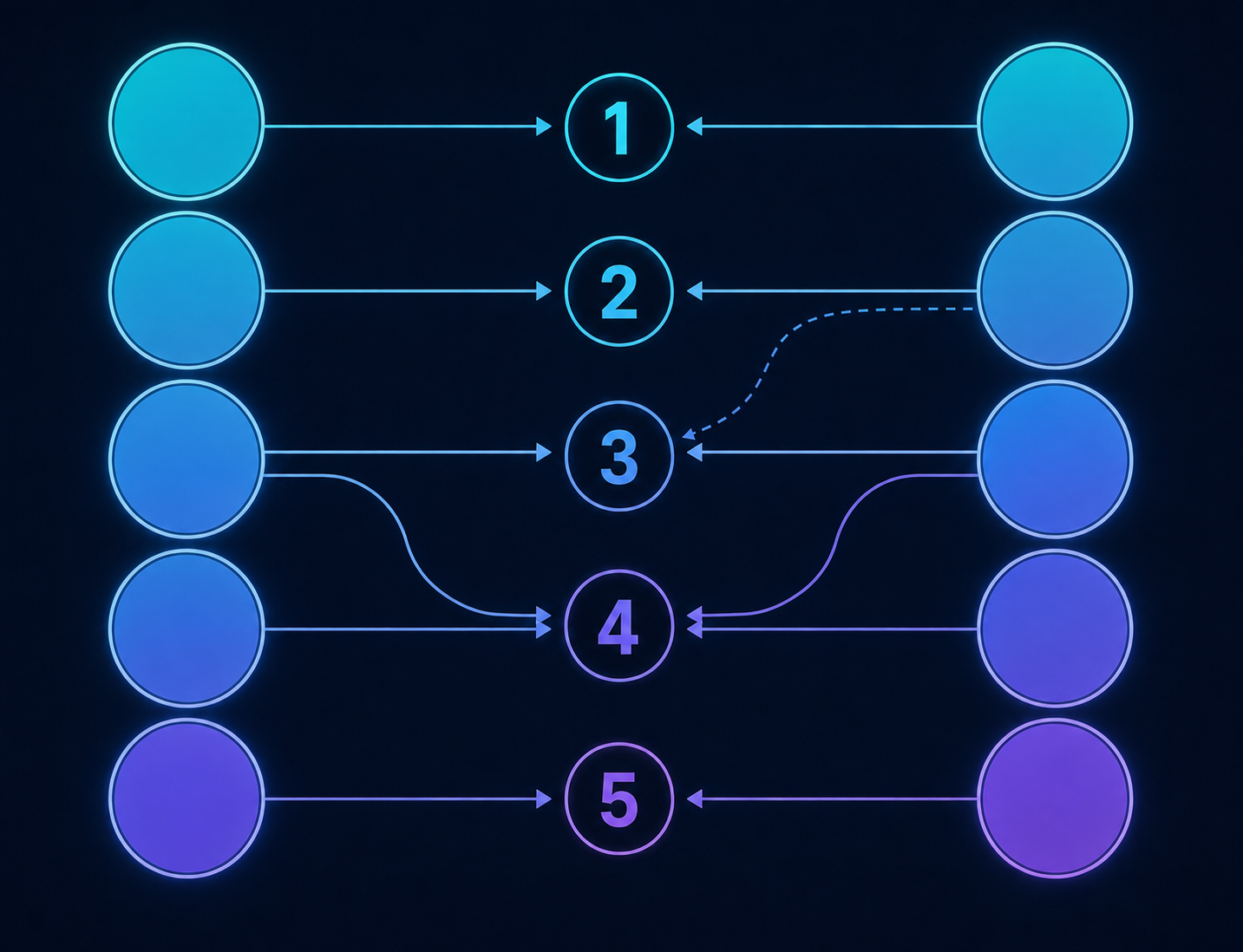
Remember the workflow: DWI drives peripheral zone scoring, T2 drives transition zone scoring, and DCE mainly helps decide whether a peripheral zone PI-RADS 3 lesion should be upgraded. PI-RADS should always be interpreted with the full MRI exam, sequence quality, PSA density, prior biopsy history, and clinical context.