




PI-RADS v2.1
Assistant
PI-RADS Assistant computer icon

Read PI-RADS v2.1 ↗
1. Lesion location
Select lesion location. Choose multiple zones only if the lesion crosses boundaries or the origin is uncertain.
Axial prostate zonal anatomy schematic
Click the image or the zone descriptions to select zone(s).
Selected zone(s)-
Dominant sequence-
DCE role-
Contrast administered? Determines DCE availability
Why zone matters: PI-RADS scoring depends on lesion location. Peripheral zone lesions follow a DWI/ADC-dominant pathway, while transition zone and anterior lesions follow a T2 morphology-dominant pathway. Read the overview.
Choose a lesion location to set the suggested workflow order.
ADC / high b-value DWI descriptor Dominant sequence for PZ
T2 morphology descriptor Dominant sequence for TZ / anterior pathway
If a lesion crosses zones, choose the single T2 description that best matches the lesion morphology. The PZ pathway still follows DWI ± DCE; this T2 selection lets the assistant calculate the TZ/anterior pathway.
DCE behavior Only changes PZ lesions when DWI is 3
DCE will be ignored unless a peripheral-zone calculation has DWI score 3.
Size / invasive behavior modifier Applies only through PI-RADS v2.1 rules
Educational decision support • Not a substitute for radiologist judgment
Advertisement
Quick guide

PI-RADS v2.1 Quick Guide

PI-RADS v2.1 is a standardized prostate MRI scoring system used to estimate the likelihood of clinically significant prostate cancer and communicate findings consistently.
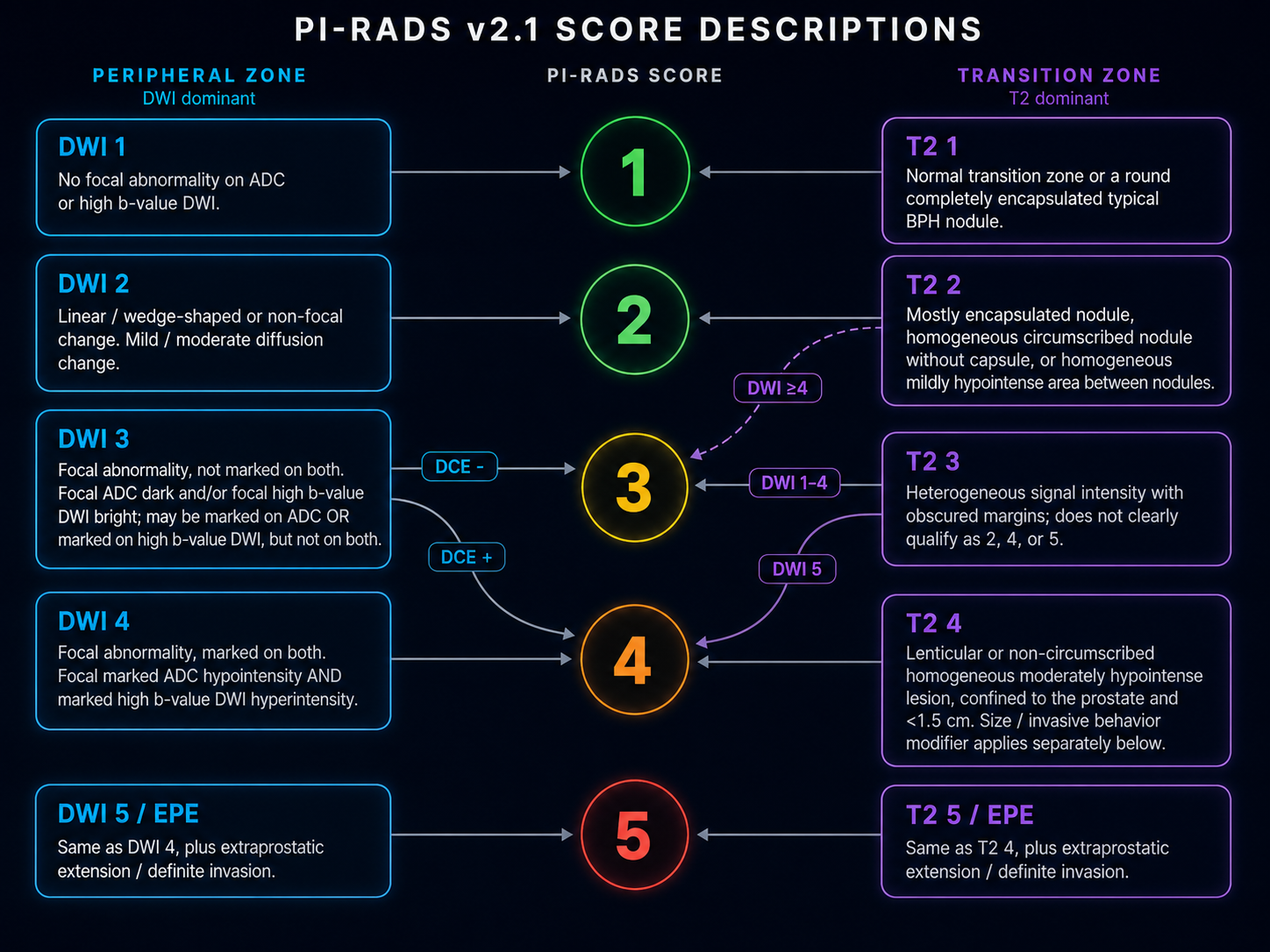
PERIPHERAL ZONE DWI dominant PI-RADS TRANSITION ZONE T2 dominant DCE - DCE + DWI ≥4 DWI 1-4 DWI 5 1 2 3 4 5 DWI 1 DWI 2 DWI 3 DWI 4 DWI 5 / EPE T2 1 T2 2 T2 3 T2 4 T2 5 / EPE

The PI-RADS score

ScoreMeaning
PI-RADS 1Very low suspicion
PI-RADS 2Low suspicion
PI-RADS 3Intermediate / equivocal
PI-RADS 4High suspicion
PI-RADS 5Very high suspicion

Peripheral zone: DWI is dominant

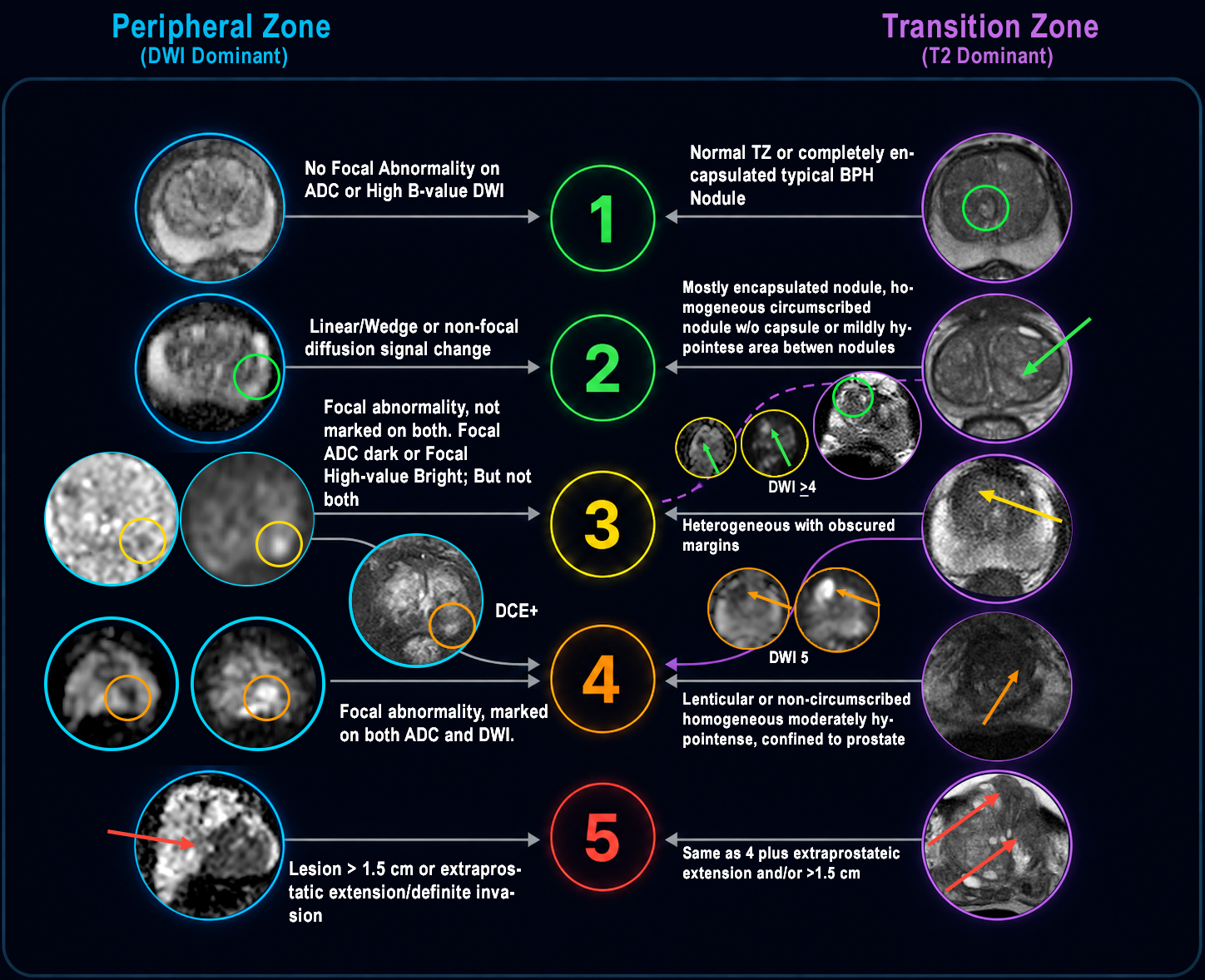
Peripheral zone lesions are scored primarily by ADC and high b-value DWI. A focal lesion that is dark on ADC and bright on high b-value DWI is more suspicious than a vague, linear, wedge-shaped, or diffuse abnormality.

Transition zone: T2 is dominant

Transition zone lesions are scored primarily by T2 morphology. Suspicious features include a lenticular or non-circumscribed shape, homogeneous moderate T2 hypointensity, and more invasive behavior. DWI can modify selected borderline TZ lesions, but it is not the dominant sequence.

When does DCE matter?

DCE has a limited but important role. In the peripheral zone, positive focal early enhancement can upgrade an otherwise PI-RADS 3 lesion to PI-RADS 4. DCE generally does not drive transition zone scoring.

Image quality caveat

If DWI or DCE is technically inadequate or not performed, PI-RADS assigns that component an “X.” Inadequate DWI is a major limitation, especially for peripheral-zone assessment. If DWI and DCE are both inadequate or absent, assessment should be limited to staging for extraprostatic extension.

Bottom line

Remember the workflow: DWI drives peripheral zone scoring, T2 drives transition zone scoring, and DCE mainly helps decide whether a peripheral zone PI-RADS 3 lesion should be upgraded. PI-RADS should always be interpreted with the full MRI exam, sequence quality, PSA density, prior biopsy history, and clinical context.

Related tools and articles

References and further reading

PI-RADS v2.1: Frequently Asked Questions

What is PI-RADS v2.1 and who publishes it?
PI-RADS (Prostate Imaging Reporting and Data System) v2.1 is a standardized prostate MRI scoring system published by the American College of Radiology (ACR) and the European Society of Urogenital Radiology (ESUR). Scores range from 1 (very low suspicion for clinically significant cancer) to 5 (very high suspicion). The system was updated from v2 to v2.1 in 2019 to refine transition zone scoring rules and clarify the role of DCE.
What is the dominant sequence for peripheral zone versus transition zone lesions?
For peripheral zone lesions, DWI/ADC is the dominant sequence. Focal marked ADC hypointensity with corresponding high b-value DWI signal is the most suspicious pattern. For transition zone and anterior lesions, T2 morphology is dominant. This zone-based approach reflects the fact that BPH creates background diffusion restriction in the TZ, making T2 morphology more specific for malignancy in that location.
When does DCE change the PI-RADS category?
In the peripheral zone only, positive focal early enhancement can upgrade a DWI score 3 lesion from PI-RADS 3 to PI-RADS 4. DCE does not drive transition zone scoring. If contrast is not administered (biparametric MRI), a PZ DWI 3 lesion cannot be upgraded by DCE and remains PI-RADS 3. DCE also does not apply to the size or EPE modifier used for upgrading a score-4 pattern to PI-RADS 5.
What does a PI-RADS 3 score mean clinically?
PI-RADS 3 is an intermediate or equivocal category indicating that clinically significant prostate cancer is possible but uncertain. Management depends on clinical context including PSA density, prior biopsy results, and patient risk profile. PSA density is particularly useful for stratifying PI-RADS 3 findings: a very low PSA density may support surveillance or close follow-up, while a higher density may prompt targeted biopsy. Local practice guidelines should guide the final management decision.

Reviewed by Nick Shaheen, MD, board-certified radiologist